Best Cybersecurity Books for 2026

March 2026
The best cybersecurity books for 2026 cover four areas: beginner foundations, blue team and incident response, offensive security, and AI security. The right starting point depends on where you are in your career. Most reading lists ignore that context. This one is designed to help you find what's relevant
I genuinely love finding books that help me approach topics and inspire me to learn more or important field manuals to understand the array of tools and commands at your disposal . Every recommendation here fits one of those two criteria: I have used it, or practitioners I trust have told me it changed how they work.
Some of the links below are Amazon affiliate links. If you buy through them I earn a small commission at no extra cost to you. It helps keep CyberDesserts free and independent.
What Are the Best Cybersecurity Books?
The best cybersecurity books for practitioners in 2026 include Linux Basics for Hackers for beginners, the Blue Team Handbook by Don Murdoch and the BTFM by White and Clark for defensive security, The Hacker Playbook 3 by Peter Kim for offensive security, and Not with a Bug, But with a Sticker for AI security. No single book covers all of these areas. Each is an insight into its own domain. The sections below are ordered to match the natural learning progression, from foundations upward.
Books Are a Starting Point, Not a Finish Line
Before getting into the list, something worth saying clearly: no book alone makes you a security practitioner. It builds the mental model. What you do with it determines whether that model translates into capability.
The practitioners I have seen develop fastest combine reading with a range of other activities running in parallel. A home lab where you can break things safely without consequence. A mentor or senior colleague whose instincts you can borrow before you develop your own. Community events where you hear how other practitioners think, local BSides conferences, SANS summits, open OWASP chapter meetings. Research habits that keep you current, following threat intelligence feeds, CVE disclosures, and the practitioners publishing primary research. And increasingly, AI tools as a study companion: ask a model to explain a concept differently because it didn't quite land, to quiz you on a concept you just read about, or to walk you through a scenario you are not familiar with in a lab.
The books below are the foundation. Build the rest around them.
Best Cybersecurity Books for Beginners
The best cybersecurity books for beginners are Linux Basics for Hackers by OccupyTheWeb and Practical Packet Analysis by Chris Sanders. Both are hands-on, assume limited prior knowledge, and build the skills that come up in blue team interviews.
Most beginners land on a certification path before they have read anything. That is not the wrong move, but it often means spending months on exam prep without building the mental model that makes the content stick. The two books here fix that.
What to do with these books: Work through them sequentially rather than dipping in and out. Both are structured to build on earlier chapters. Pair them with a free TryHackMe or HackTheBox account so you are applying each concept in a lab environment within a day or two of reading it. The gap between reading and doing is where you want to compound that momentum.
Linux Basics for Hackers by OccupyTheWeb is the most practical introduction to Linux from a security perspective available. It covers command-line basics, scripting, networking tools, and the file permissions model that underpins most of what you will do in a SOC. The exercises are designed around Kali Linux, so everything you build transfers directly to a lab environment. If you are coming from a Windows IT background or a non-technical role, this is where you start.
Practical Packet Analysis by Chris Sanders teaches network traffic analysis using Wireshark, working through real capture files rather than manufactured examples. Knowing what a normal TCP handshake looks like, being able to spot a beaconing pattern, understanding what DNS should and should not be doing on your network: these are the skills that separate analysts who can triage alerts from those who cannot. Sanders writes the way a good instructor teaches, clearly and without condescension.
Read both before committing significant time to any certification programme. They will tell you whether the operational side of security is where you want to be, and they will give you something concrete to discuss in an interview.
The 3rd edition dates from 2017 and the Wireshark interface has moved on since, but the underlying methodology and protocol fundamentals are unchanged and still the right starting point.
For a broader view of where these foundations lead, the Cybersecurity Skills Roadmap maps the full landscape across every specialisation so you can make an informed choice about direction.
Linux Basics for Hackers by OccupyTheWeb
Practical Packet Analysis by Chris Sanders
Best Blue Team Books for SOC Analysts and Incident Responders
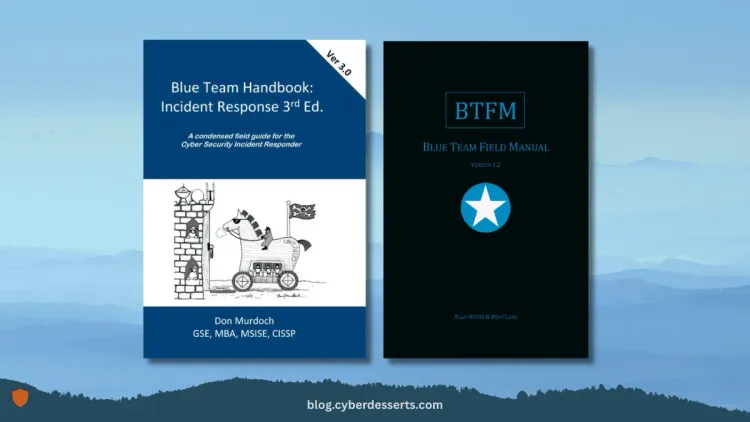
The best blue team books for SOC analysts and incident responders are the Blue Team Handbook: Incident Response Edition by Don Murdoch and the Blue Team Field Manual by Alan J. White and Ben Clark. The Handbook builds the mental model. The BTFM is the tactical reference you reach for during an investigation.
Getting good at defensive security requires understanding both the process of incident response and the command-line work that supports it. These two cover both ends.
How to approach these books: Read the Handbook to build your mental model of how IR works end to end. Use the BTFM alongside real investigations, whether that is in a lab or a live environment. Pull it out when you need the exact command rather than trying to recall it from memory. The two work best as a pair, not as alternatives.
The Blue Team Handbook: Incident Response Edition by Don Murdoch is the strongest starting point regardless of where you are in your career. It has been the go-to field guide for SOC analysts and incident responders for over a decade, and the timing to pick it up could not be better.
Version 3 dropped on Amazon in December 2025, adding 164 pages of new material and making it roughly 180% larger than the original publication. The O'Reilly professional edition followed in March 2026. Either format gives you the same essential content.
What makes it valuable for a career changer is the same thing that makes it useful for a seasoned analyst: it is zero fluff. The focus is on the incident response process, network analysis methodology, Windows and Linux analysis procedures, indicators of compromise, and practical tool usage. No theory for the sake of theory.
Most security books date themselves within two years. This one keeps getting updated because the core IR process it describes does not change as fast as the tooling around it.
Blue Team Handbook: Incident Response Edition by Don Murdoch
The O'Reilly professional edition by Don Murdoch (Released March 2026)
The Blue Team Field Manual (BTFM) sits alongside the Handbook rather than replacing it, and the two work better together than either does alone.
The one to buy is the original by Alan J. White and Ben Clark (2017, ISBN: 9781541016361). That is the version every practitioner reading list refers to and the one consistently recommended alongside the Blue Team Handbook.
The 2017 date is worth acknowledging. The core commands and NIST framework alignment hold up well because the fundamentals of incident response and defensive tooling do not shift as fast as threat intelligence does. It is still what practitioners find useful.
Where the Handbook explains the incident response process and builds your mental model, the BTFM is a tactical command-line reference aligned to the NIST Cybersecurity Framework's five core functions: Identify, Protect, Detect, Respond, and Recover. Note that Govern, added as a sixth function in the updated NIST CSF 2.0, is not covered in the 2017 edition.
For someone transitioning into blue team from IT, networking, or a non-technical background, working through both in parallel is the right approach. Read the Handbook to understand why you are running a particular analysis. Flip to the BTFM when you need the exact command in the moment. For working analysts who already know the process, the BTFM alone is a useful desk reference that fills in command-line gaps without requiring you to re-read fundamentals you already know.
Both are slim volumes. Neither will bury you in theory.
Blue Team Field Manual (BTFM) by Alan J. White and Ben Clark
Best Offensive Security and Red Team Books for 2026
Understanding offensive security makes you a better defender. Knowing how attacks are structured, what adversaries prioritise when they move laterally, and why certain controls fail under pressure changes how you think about detection and response. You do not need to pursue an offensive role to benefit from reading in this area.
One thing worth saying clearly: in offensive security, a lab will teach you more than a book. Books in this area date faster than any other category, tools change, targets change, and evasion techniques move quickly. Read to understand the methodology. Build in the lab to develop the skill. The cybersecurity practice lab setup guide covers the environment you need, and platforms like TCM Security, OffSec's learning path, and HackTheBox Academy will keep your tooling knowledge current in ways no printed book can.
Cloud environments deserve a specific mention here. Modern penetration testing increasingly means cloud infrastructure, and AWS and Azure both provide free resources that belong in any offensive security learning path. AWS offers hands-on security labs through AWS Skill Builder, and deliberately vulnerable environments like CloudGoat by Rhino Security Labs let you practise cloud attack techniques in a safe context. Microsoft Learn includes dedicated Azure security paths covering identity attacks, misconfiguration exploitation, and privilege escalation in cloud environments. Neither replaces the foundational methodology below, but neither should be left off the list.
The Hacker Playbook 3 by Peter Kim covers the methodology and real engagement scenarios that the lab work needs to be built around. Initial access, lateral movement, evasion, reporting: the structure mirrors how engagements actually run. Version 3 adds Active Directory attacks and adversary simulation techniques that have become standard in modern red team work. Analysts on the blue side will find it as useful as red teamers building out their approach.
Hash Crack: Password Cracking Manual v3 by Joshua Picolet is a specialist desk reference, not a general introduction. Dense command-line coverage of hash extraction and syntax for Hashcat and John the Ripper. Every page is practical. I got a copy on the recommendation of Will Hunt, who spoke about password cracking at BSides with genuine passion for the subject. The reference guide delivers.
The Hacker Playbook 3 by Peter Kim
Hash Crack: Password Cracking Manual v3 by Joshua Picolet
Best Resources for AI Security and Emerging Threats
AI security is the one area in this list where the frameworks beat the books. The threat landscape is moving faster than any publication cycle can match. The right approach is different here: use a book to build the mental model, then treat the frameworks below as the living documentation that replaces anything printed.
Not with a Bug, But with a Sticker: Attacks on Machine Learning Systems and What To Do About Them is the most accessible starting point for understanding how adversarial attacks on AI systems are structured. It covers adversarial examples, data poisoning, and model evasion without requiring a machine learning background. The title comes from research showing that physical stickers placed on objects can cause image classifiers to misidentify them entirely. That framing captures the approach: concrete, verifiable, practitioner-relevant. Read it first. Then move to the frameworks, because the book predates the agentic AI threats that are now the most active part of this space.
Not with a Bug, But with a Sticker
For staying current, four resources belong in your regular rotation:
The OWASP LLM Top 10 (2025) is the primary risk taxonomy for LLM applications, covering prompt injection, sensitive information disclosure, supply chain vulnerabilities, and excessive agency among others. The starting point for anyone securing or assessing LLM-based systems.
The OWASP Top 10 for Agentic Applications 2026, released December 2025, is the newer framework covering autonomous AI agents specifically. As agents gain access to email, code execution, and APIs, the risk profile changes fundamentally from a standard LLM deployment. This is the framework your SOC needs to be reading now, not in six months.
MITRE ATLAS (v5.4.0, February 2026) maps adversary tactics and techniques specific to AI systems, now covering 84 techniques across 16 tactics. The February 2026 update added agentic-specific techniques. Use ATLAS Navigator alongside this to model threats against AI deployments in your environment.
NIST AI RMF with the GenAI Profile (AI 600-1) provides 200+ suggested risk management actions and is the governance reference that aligns with EU AI Act requirements. Less hands-on than the OWASP and ATLAS frameworks, but important context if your role involves advising on AI risk posture rather than testing it.
For practitioner-level coverage of how these threats are emerging in the wild, the CyberDesserts AI security articles cover prompt injection, agentic threats, and LLM governance as they develop, bridging the gap between framework releases and what is showing up in real environments.
Practitioner Picks: Books Worth Reading Beyond the Standard List
Every practitioner who reads widely has a list that does not appear on standard recommendations. These are mine. None of them fit neatly into a single category, which is exactly why they are worth reading.
Additional reading: These are not study materials in the traditional sense. Read Intrusion Detection Honeypots when you are thinking about detection architecture and want a fresh approach. Read Worm when you want to understand the human and organisational dynamics of a major incident rather than the technical mechanics. Read Modern Cybersecurity when you are trying to think about the security programme you are building or working within, not the individual task in front of you. These are the books you come back to between study phases, not the ones you grind through in sequence.
Intrusion Detection Honeypots: Detection through Deception by Chris Sanders (Applied Network Defence, 2020) is the best book on practical honeypot deployment available and one of the most under recommended books in the defensive security space. Sanders introduces the See-Think-Do framework for planning honeypot-based detection, then walks through honey services mimicking HTTP, SSH, and RDP, honey tokens hidden in documents and file shares, honey credentials, and unconventional techniques that most teams have never considered.
I have built a few honeypots over the years and this book is inspiring to do more, I have a future lab I am working on that you can follow to build your own honeypot.
The core principle is simple: anything that touches a honeypot is almost certainly malicious. The execution is what this book makes possible. I read a lot of security books. This one immediately changed how I think about detection architecture.
Worm: The First Digital World War by Mark Bowden (2011) is not a technical manual. It is narrative non-fiction about the Conficker worm and the coalition of researchers, geeks, and internet entrepreneurs who formed the Conficker Cabal to fight it. Bowden is the author of Black Hawk Down and brings the same ability to turn a complex, high-stakes situation into a story you cannot put down. Having lived through Conficker as a first responder, watching the threat evolve over days and weeks in real time was something I had not experienced before. It changed how the whole industry approached large-scale response.
Conficker infected over twelve million computers across 195 countries within a month of its first appearance in November 2008 and sat dormant long enough to become the largest botnet ever assembled. Reading this gives you a ground-level understanding of how a major incident unfolds, how the response community functions, and why the gap between technical knowledge and organisational response remains the most dangerous vulnerability in security. It is the book I give to people who want to understand what this industry is dealing with.
Modern Cybersecurity: Tales from the Near-Distant Future edited by Mark Miller (2021) is eight practitioner essays on building security programmes that work. Contributors include Sounil Yu, creator of the Cyber Defence Matrix, alongside Caroline Wong, Keyaan Williams, and others who have built and broken real programmes. Each essay comes from someone who ran into the problem they are describing and found a way through it. It is not vendor content dressed up as guidance. For anyone in a role that involves building or improving a security programme rather than purely operating one, it is the most practically useful thing on this list. The digital version is available as a free download if you want to assess it before purchasing a hard copy.
Intrusion Detection Honeypots by Chris Sanders
Worm: The First Digital World War by Mark Bowden
Modern Cybersecurity: Tales from the Near-Distant Future by Mark Miller
How to Choose the Right Cybersecurity Books for Your Career Stage
The most common mistake is buying books aimed at the wrong career stage. A SOC analyst working through red team methodology without defensive fundamentals gains theory without application. A senior practitioner rereading introductory material is wasting time that could go into applied work. It is also important to match the books to your skill level and what you are comfortable with.
Here is how to match the book to the stage.
Breaking into cybersecurity from IT, help desk, or a non-technical background: Start with Linux Basics for Hackers and Practical Packet Analysis. Then the Blue Team Handbook. In that order. Do not move to anything else until you have worked through exercises from all three.
Already working in a SOC at Tier 1 or Tier 2: The Blue Team Handbook Version 3 fills process gaps that operational experience alone does not always close. Intelligence-Driven Incident Response by Roberts and Brown is the logical next step, specifically if you are moving towards threat intelligence integration.
In a security-adjacent role, GRC, cloud, IT management, or DevSecOps: Modern Cybersecurity gives you the programme perspective. The Blue Team Handbook gives you the operational one. Between them, they cover the gap.
Building towards an offensive role or OSCP: The Hacker Playbook 3 by Peter Kim is the starting point for red team methodology and engagement structure. Add Hash Crack when credential-based techniques become part of your practice.
Working in or moving into AI security: Not with a Bug, But with a Sticker by Ram Shankar Siva Kumar and Hyrum Anderson builds the mental model. The OWASP LLM Top 10, the OWASP Top 10 for Agentic Applications 2026, and MITRE ATLAS keep it current. No book publishes faster than this threat moves.
The biggest mistake is reading without building and documenting your journey. Most of the books on this list have a direct application to a lab environment or a live environment. The cybersecurity practice lab setup guide covers the environment you need.
Where to Go After These Books
The Cybersecurity Skills Roadmap maps the full picture across every specialisation, SOC analyst, incident response, cloud security, GRC, and more, so you can make an informed choice rather than defaulting to what everyone else is doing.
If you are a graduate or career changer working towards your first security role, the Cybersecurity Graduate Career Guide covers the gap between where you are now and day one in a SOC. If you are still deciding which direction suits you, the Cybersecurity Career Paths guide breaks down roles, required skills, and realistic entry points.
Once you have a direction, the cybersecurity practice lab setup guide and the ELK Stack security monitoring tutorial are where you start building the hands-on evidence that gets you hired or promoted.
For a hands-on introduction to session hijacking and cookie security, the CookieJar Lab walks through a real attack in 60 seconds with no setup required. The full lab lets you run it against sessions you create yourself.
Have a question about getting into cybersecurity or building blue team skills? Get in touch
Subscribe for weekly practical security content. No fluff.
Last updated: March 2026
Frequently Asked Questions
What are the best cybersecurity books?
The best cybersecurity books for practitioners in 2026 cover four areas: beginner foundations, blue team and incident response, offensive security, and AI security. Linux Basics for Hackers and Practical Packet Analysis are the correct starting point for beginners. The Blue Team Handbook by Don Murdoch and the BTFM by White and Clark are the two most consistently recommended defensive reads. The Hacker Playbook 3 by Peter Kim leads the offensive list. Not with a Bug, But with a Sticker is the clearest practitioner introduction to AI security risks.
What are the best cybersecurity books for beginners?
The best cybersecurity books for beginners are Linux Basics for Hackers by OccupyTheWeb and Practical Packet Analysis by Chris Sanders. Both assume limited prior knowledge, focus on hands-on skills rather than theory, and build directly applicable capability in Linux fundamentals and network traffic analysis. They are the correct starting point before committing to a certification programme or moving into more advanced material.
What are the best blue team cybersecurity books?
The Blue Team Handbook: Incident Response Edition by Don Murdoch and the Blue Team Field Manual (BTFM) by Alan J. White and Ben Clark are the two most consistently recommended books across the practitioner community. The Handbook covers incident response process, network analysis, and Windows and Linux forensics. The BTFM is a tactical command-line reference aligned to the NIST Cybersecurity Framework. Version 3 of the Handbook was released in December 2025.
Are blue team books useful if you are already working in cybersecurity?
Yes. Many working security professionals in GRC, cloud, IT management, or red team roles have not been formally exposed to blue team fundamentals. The Blue Team Handbook is a quick read that builds a clear mental model of how SOC operations and incident response are structured. Working SOC analysts who have not read it often find it fills gaps in process knowledge that experience alone does not always cover.
What is the difference between the Blue Team Handbook and the BTFM?
The Blue Team Handbook explains the incident response process and builds your understanding of how to approach defensive security. The Blue Team Field Manual (BTFM), the original 2017 edition by Alan J. White and Ben Clark, is a tactical command-line reference aligned to the NIST Cybersecurity Framework. They are complementary, not interchangeable. Most practitioners keep both on their desk.
What are the best offensive security and red team books?
The best offensive security books for 2026 are The Hacker Playbook 3 by Peter Kim and Hash Crack: Password Cracking Manual v3 by Joshua Picolet. Kim covers full engagement methodology including Active Directory attacks and adversary simulation. Hash Crack is the specialist desk reference for credential-based testing. For cloud environments, AWS Skill Builder, CloudGoat, and Microsoft Learn provide hands-on context no printed book currently matches.
What cybersecurity books cover AI security threats?
The best practitioner-focused book on AI security is Not with a Bug, But with a Sticker by Ram Shankar Siva Kumar and Hyrum Anderson, which covers adversarial examples, data poisoning, and model evasion without requiring a machine learning background. For staying current, the OWASP LLM Top 10, the OWASP Top 10 for Agentic Applications 2026, and MITRE ATLAS are updated continuously and should be read alongside it. No book in this space publishes faster than the threat moves, so the frameworks carry as much weight as the reading.
What blue team books are good for career changers?
The Blue Team Handbook is specifically well-suited to career changers because it explains the process behind incident response rather than assuming prior knowledge. It maps familiar concepts from IT, networking, and systems administration to a blue team context. Linux Basics for Hackers and Practical Packet Analysis are the correct starting point before the Handbook if you are coming from a non-technical background.
Do you need coding skills to benefit from blue team books?
No. Neither the Blue Team Handbook nor the BTFM requires coding knowledge. Both focus on defensive processes, command-line tools, and incident response methodology. Basic familiarity with Linux commands is helpful but not a prerequisite, and both books help build that familiarity as you work through them.
Is the Blue Team Handbook good for SOC analysts?
Yes. It was written for SOC analysts and incident responders. Version 3 includes updated coverage of how modern adversaries operate, structured IR procedures, forensic analysis on Windows and Linux systems, and network traffic analysis. Analysts at Tier 1 and Tier 2 level consistently report it fills gaps in process knowledge that operational experience alone does not always cover.
References
- Don Murdoch. (2025). Blue Team Handbook: Incident Response Edition, Version 3. Amazon (December 2025); O'Reilly Media (March 2026).
- Alan J. White, Ben Clark. Blue Team Field Manual (BTFM). ISBN: 9781541016361. Aligned to NIST Cybersecurity Framework.
- OccupyTheWeb. Linux Basics for Hackers. No Starch Press.
- Chris Sanders. Practical Packet Analysis. No Starch Press.
- Peter Kim. The Hacker Playbook 3. Secure Planet.
- Joshua Picolet. Hash Crack: Password Cracking Manual v3. Independently published (2019). ISBN: 9781793458612.
- Chris Sanders. Intrusion Detection Honeypots: Detection through Deception. Applied Network Defense (2020). ISBN: 9781735188300.
- Mark Bowden. Worm: The First Digital World War. Atlantic Monthly Press (2011).
- Mark Miller (ed). Modern Cybersecurity: Tales from the Near-Distant Future. Independently published (2021). ISBN: 9798491123124.
- OWASP LLM Top 10. https://owasp.org/www-project-top-10-for-large-language-model-applications/
- MITRE ATLAS. https://atlas.mitre.org/
- Ram Shankar Siva Kumar, Hyrum Anderson. Not with a Bug, But with a Sticker: Attacks on Machine Learning Systems and What To Do About Them. Foreword by Bruce Schneier. (May 2023).
- OWASP Top 10 for Agentic Applications 2026. https://genai.owasp.org/resource/owasp-top-10-for-agentic-applications-for-2026/
- NIST AI Risk Management Framework — GenAI Profile (AI 600-1). https://airc.nist.gov/Docs/1




Member discussion