Cybersecurity Graduate Guide: From Degree to First Job

Cybersecurity graduates can bridge the gap between degree and first job by building hands-on skills in four areas most programmes underserve: networking fundamentals, cloud security, governance frameworks, and AI/automation.
The global cybersecurity workforce gap stands at 4.8 million unfilled positions (ISC2, 2025). Two out of three organisations report active staffing shortages. Those numbers should be encouraging if you are finishing a cybersecurity or computer science degree. The demand is real.
Here is the problem. Employers are not hiring based on your transcript. They are hiring based on what you can demonstrate. In my experience working with enterprise security teams for over 20 years, the graduates who land roles fastest are not the ones with the highest marks. They are the ones who closed the gap between academic knowledge and job-ready skills before graduation day.
This guide maps exactly what that gap looks like and how to close it.
Get career insights like this delivered to your inbox. Subscribe to CyberDesserts for practical security insights, no fluff.
What Skills Do Cybersecurity Graduates Need?
Most degree programmes cover theory well. They rarely cover the tools and workflows hiring managers screen for. This matrix shows what each career level demands across core security domains, starting with the foundational skills your degree should have covered and the entry-level skills employers expect on day one.
| Domain | Foundational (New Grad) | Entry-Level (SOC / Junior) | Mid-Level | Senior / Lead |
|---|---|---|---|---|
| SOC / Detection | OS internals (Linux/Windows), log analysis | Alert triage, SIEM basics (Splunk/ELK) | Detection rule writing (Sigma, YARA) | Detection engineering program design |
| Networking | TCP/IP, DNS, HTTP, subnetting, Wireshark | Firewall/IDS monitoring, VPN basics | Network traffic analysis, PCAP forensics | Zero Trust Architecture design |
| Cloud Security | Shared responsibility model, cloud models (SaaS/IaaS) | IAM auditing, AWS/Azure Security Hub | CSPM implementation, K8s security | Multi-cloud architecture, cloud-native SOC |
| Offensive Security | OWASP Top 10, port scanning, scripting | Web app pentest methodology | AD attack chains, vulnerability chaining | Red team planning, custom C2 development |
| Incident Response | IRP phases, artifact collection | Evidence preservation, phishing triage | Memory forensics, malware triage | IR program architecture, APT analysis |
| GRC / Policy | CIA Triad, data privacy (GDPR/CCPA) | Risk assessment basics, NIST vs ISO | Cross-framework mapping, SOC 2 | Risk quantification (FAIR), board reporting |
| AI Security | Prompting basics, AI ethics | Prompt injection, OWASP LLM Top 10 | LLM production security, AI red teaming | AI security governance and program development |
| Tools & Automation | Basic Python, CLI (Bash/PowerShell) | Nmap, tcpdump, API basics | Python automation, Elastic Stack | Custom tool development, CI/CD security |
Source: CyberDesserts analysis of job posting requirements and practitioner community data, February 2026
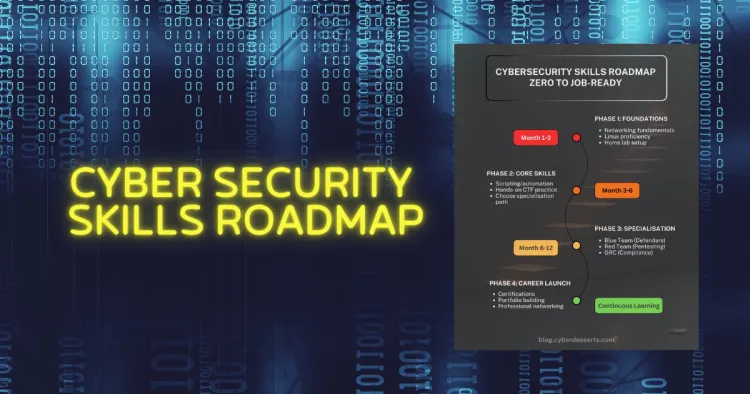
For the full progression path across all ten security domains with tool recommendations at each level, see the Cybersecurity Skills Roadmap.
Focus on the Foundational and Entry-Level columns. If you can demonstrate competence across those two levels, you are ahead of most graduates applying for the same roles.
What A Cybersecurity Degree Does Not Teach You
If you have the degree but struggle to land interviews, these are the four areas most degree programmes underserve. If you are still studying, start building these now alongside your coursework.
1. Networking Fundamentals for Security Roles
Do not just know the OSI model. Know how to read a packet. Employers expect graduates to understand how traffic flows across real networks, not just draw diagrams of them.
Recommended: CCNA remains the gold standard for networking depth. CompTIA Network+ is a solid alternative if time is limited.
Action: Build a home lab with OPNsense or pfSense to route your own traffic. Capture packets with Wireshark and practise reading TCP handshakes, DNS queries, and HTTP headers. This is the kind of hands-on project that impresses in interviews. Our cybersecurity practice lab setup guide walks through the process.
2. Cloud Security Skills for Beginners
Security is overwhelmingly cloud-based now. 74% of organisations report a shortage of cybersecurity talent, with gaps especially acute in cloud-specific roles (Cybersecurity Insiders / Fortinet, 2026). You need to understand Identity and Access Management (IAM) its the new perimeter.
Recommended: AWS Certified Cloud Practitioner or Microsoft Azure AZ-900 as a starting point, followed by AZ-500 for security specialisation.
Action: Use AWS free tier or Azure student credits to deploy a basic environment. Audit IAM policies. Learn Microsoft Sentinel or AWS Security Lake. Our February 2026 Career Report breaks down the cloud security career path in detail.
3. Cybersecurity Frameworks Every Graduate Should Know
Technical skills are difficult to apply if you do not understand the governance and compliance landscape that shapes how organisations actually operate. The vendor pitch says "deploy our tool." The reality in most organisations is "prove it meets the compliance requirement first and provides real value"
Recommended: Study the NIST Cybersecurity Framework (CSF) 2.0 and ISO 27001 fundamentals.
Quick win: The ISC2 Certified in Cybersecurity (CC) is often free and covers GRC basics. It is a low-cost signal to employers that you understand the rules of the road.
4. AI and Automation Skills for Cybersecurity
41% of organisations cite AI security as their biggest skills gap (ISC2, 2024). This is not about replacing your skills with AI. It is about using AI to defend and understanding how to secure AI systems themselves.
Recommended: Google's AI Essentials or DeepLearning.AI's "Generative AI for Everyone" for foundational understanding.
Action: Use Python to automate log parsing. Use ChatGPT or Claude to help write Sigma detection rules, then validate the output manually. That combination of AI-assisted workflow plus human verification is exactly what employers want to see.
Building your security skills? Try our CyberDesserts Learning Assistant for personalised guidance on your learning path.
Cybersecurity Certification Roadmap for 2026
Certifications are not a substitute for skills, but they get your CV past the HR filter. Here is the sequence that maps to career progression.
Start here: CompTIA Security+. It remains the most widely requested certification in entry-level job postings. Treat it as a baseline, not an achievement.
Specialise based on your path:
- Blue Team (SOC, detection, IR): BTL1 (Blue Team Level 1) or CompTIA CySA+
- Red Team (pentesting, offensive security): PJPT (Practical Junior Penetration Tester) or work towards OSCP
- Cloud Security: CCSP or AWS Security Specialty
End game (after 5+ years experience): CISSP or CISM. These require professional experience so they are not relevant yet, but knowing they exist helps you plan your trajectory.
For a detailed breakdown of certifications mapped to career stage, cost, and which domains they serve, see the certification guide in our Career Report.
How to Get Hired in Cybersecurity With No Experience
I have seen hundreds of candidates go through interview processes with enterprise security teams. The graduates who stand out do three things.
They build something visible. A home lab does not mean a rack of old hardware in your spare room. Deploying a SIEM on AWS free tier, running a detection tool on Railway, or hosting a security dashboard on Vercel counts. These platforms are cost-effective (often free for small projects), and the process of deploying, securing, and optimising a cloud-hosted tool teaches you more about real-world infrastructure than any textbook. You learn IAM configuration, cost management, container orchestration, and attack surface reduction all at once, skills that map directly to what employers need.
A GitHub repository with your detection rules, a write-up of a TryHackMe or HackTheBox challenge, or a live tool you can demo in an interview all qualify. Our Docker for cybersecurity guide is a good starting point for building portable lab environments you can deploy anywhere.
They articulate the "why" behind the "what." Anyone can list tools on a CV. Explaining why you chose ELK over Splunk for your lab, or why you structured your detection rules a certain way, signals genuine understanding.
They demonstrate continuous learning. The cybersecurity landscape changes weekly. Showing that you follow threat intelligence, read advisories, and update your skills proactively tells an employer you will not stagnate after onboarding.
Key Takeaways
- Your degree provides the foundation. The four pillars (networking, cloud, frameworks, AI) close the gap to employability.
- Focus on the Foundational and Entry-Level columns of the skill matrix. Demonstrate competence there before graduation.
- Security+ gets you past HR. Hands-on evidence gets you past the hiring manager.
- Build visible proof of your skills. Labs, repositories, and write-ups beat transcript grades.
- The 4.8 million workforce gap is your opportunity. The demand is real if you bring the right skills.
New career intelligence drops regularly. Subscribers get notifications when the job market shifts, plus practical security content to keep your skills sharp, in the blog articles you will get tons of ideas on things to try and where to start.
This article is part of our cybersecurity career series. See the complete guide: Cybersecurity Skills Roadmap
Last updated: March 2026
References and Sources
- ISC2. (2025). 2024 Cybersecurity Workforce Study. Global workforce gap of 4.8 million professionals, 19% increase from 2023.
- Cybersecurity Insiders / Fortinet. (2026). 2026 State of Cloud Security Report. 74% of organisations report cybersecurity talent shortage, 77% express high concern about skills gap.
- ISC2. (2024). Cybersecurity Workforce Study. 41% of organisations cite AI security as their biggest skills gap.


Member discussion