Best Blue Team Cybersecurity Books to Read in 2026
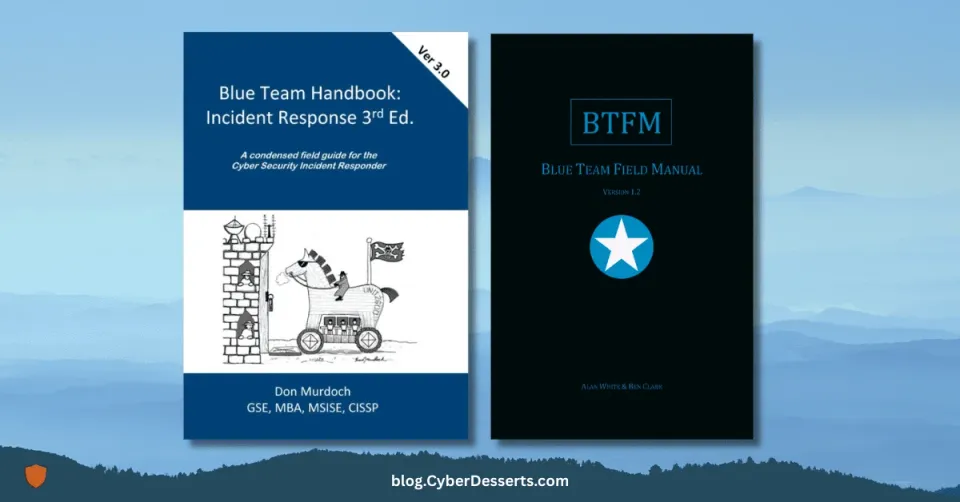
A first-year student asked me what to read for blue team. The answer surprised them, not because the list was long, but because it was short.
Get practical security reads delivered to your inbox. Subscribe to CyberDesserts for no-fluff guidance.
The two best blue team cybersecurity books:
Blue Team Handbook: Incident Response Edition (Don Murdoch) Blue Team Field Manual (BTFM)Whether you are breaking into cybersecurity, switching into a blue team role, or already working in a SOC and filling gaps in your knowledge, these two books cover the fundamentals that most practitioners wish someone had pointed them to earlier.
Most reading lists are too long. Fifteen books, half of them outdated, none of them prioritised. You do not need fifteen books to get solid on blue team fundamentals. You need two.
What Are the Best Blue Team Books for 2026?
The Blue Team Handbook: Incident Response Edition by Don Murdoch is the strongest starting point regardless of where you are in your career. It has been the go-to field guide for SOC analysts and incident responders for over a decade, and the timing to pick it up could not be better.
Version 3 dropped on Amazon in December 2025, adding 164 pages of new material and making it roughly 180% larger than the original 2014 publication. The O'Reilly professional edition drops on 31 March 2026. Either format gives you the same essential content.
What makes it valuable for a career changer is the same thing that makes it useful for a seasoned analyst: it is zero fluff. The focus is on the incident response process, network analysis methodology, Windows and Linux analysis procedures, indicators of compromise, and practical tool usage. No theory for the sake of theory. No vendor pitch dressed up as guidance.
Having worked across enterprise security teams for over 20 years, I still see copies of earlier versions of this book on analysts' desks. That is rare. Most security books date themselves within two years. This one keeps getting updated because the core IR process it describes does not change as fast as the tooling around it.
If you are looking to grab a copy, you can find it here on Amazon
Blue Team Handbook: Incident Response Edition (Don Murdoch)As an Amazon Associate, I earn a small commission if you buy through these links, at no extra cost to you. It genuinely helps keep CyberDesserts free and independent, so thank you if you do.
What Is the Blue Team Field Manual (BTFM) and Do You Need It?
Yes. The BTFM sits alongside the Handbook rather than replacing it, and the two work better together than either does alone.
A quick note before you search: there are currently two products on Amazon using the BTFM name. The one to buy is the original by Alan J. White and Ben Clark (2017, ISBN: 9781541016361). That is the version every practitioner reading list refers to and the one consistently recommended alongside the Blue Team Handbook. There is a separate "CyberOps Handbook Series" edition by a different author and publisher using the same name it is not the same book and the community consensus is that the original is significantly better. Check the author before purchasing.
The 2017 date is worth acknowledging. The core commands and NIST framework alignment hold up well because the fundamentals of incident response and defensive tooling do not shift as fast as threat intelligence does. It is still what practitioners actually have on their desks.
Where the Handbook explains the incident response process and builds your mental model, the BTFM is a tactical command-line reference aligned to the NIST Cybersecurity Framework's five core functions: Identify, Protect, Detect, Respond, and Recover.
For someone transitioning into blue team from IT, networking, or a non-technical background, working through both in parallel is the right approach. Read the Handbook to understand why you are running a particular analysis. Flip to the BTFM when you need the exact command in the moment. For working analysts who already know the process, the BTFM alone is a useful desk reference that fills in command-line gaps without requiring you to re-read fundamentals you already know.
Both are slim volumes. Neither will bury you in theory.
If you are looking to grab a copy, make sure you are picking up the original:
Blue Team Field Manual (BTFM) by Alan J. White & Ben Clark on Amazon.How Do These Books Help You Get Into Cybersecurity?
Books build the mental model that lab work and online courses often skip. Most platforms teach you to execute commands. The Blue Team Handbook teaches you why those commands matter in the context of a real incident, which is the gap that shows up in interviews and in your first weeks on the job.
If you are transitioning from IT, networking, help desk, or a non-security role, the Handbook maps directly to how blue team work is structured. You will recognise tools and concepts you already know, and see clearly where your gaps are. That clarity is worth the cover price before you spend months studying in the wrong direction.
For those already in a security-adjacent role, GRC, cloud, IT management, the Handbook is the fastest way to understand how the operational side of a SOC functions, which improves how you work with blue team colleagues and informs your own decisions around controls and risk.
Where to Go After These Two Books
Books give you the mental model. The next question is where blue team fits in the broader cybersecurity landscape and which specific role suits you.
The Cybersecurity Skills Roadmap maps the full picture across every specialisation SOC analyst, incident response, cloud security, GRC, and more so you can make an informed choice rather than defaulting to what everyone else is doing.
If you are a graduate or career changer working towards your first security role, the Cybersecurity Graduate Career Guide covers the gap between where you are now and day one in a SOC. If you are still deciding which direction in security suits you, the Cybersecurity Career Paths guide breaks down roles, required skills, and realistic entry points.
Once you have a direction, the cybersecurity practice lab setup guide and the ELK Stack security monitoring tutorial are where you start building the hands-on evidence that gets you hired or promoted.
Two books. Then a direction. Then a lab. That is the blue team starting point whether you are brand new to the field or filling in gaps in an existing career.
Frequently Asked Questions
What are the best blue team cybersecurity books?
The Blue Team Handbook: Incident Response Edition by Don Murdoch and the Blue Team Field Manual (BTFM) are the two most consistently recommended books across the practitioner community. The Handbook covers incident response process, network analysis, and Windows and Linux forensics. The BTFM is a tactical command-line reference aligned to the NIST Cybersecurity Framework. Version 3 of the Handbook was released in December 2025 with the O'Reilly edition following in March 2026.
Are blue team books useful if you are already working in cybersecurity?
Yes. Many working security professionals in GRC, cloud, IT management, or red team roles have not been formally exposed to blue team fundamentals. The Blue Team Handbook is a quick read that builds a clear mental model of how SOC operations and incident response are structured. Working SOC analysts who have not read it often find it fills gaps in process knowledge that experience alone does not always cover.
What is the difference between the Blue Team Handbook and the BTFM?
The Blue Team Handbook explains the incident response process and builds your understanding of how to approach defensive security. The Blue Team Field Manual (BTFM) the original 2017 edition by Alan J. White and Ben Clark is a tactical command-line reference aligned to the NIST Cybersecurity Framework. They are complementary, not interchangeable. Most practitioners keep both on their desk. Note: there is a separate product on Amazon using the BTFM name from a different author, the community-recommended version is the original White and Clark edition (ISBN: 9781541016361).
What blue team books are good for career changers?
The Blue Team Handbook is specifically well-suited to career changers because it explains the process behind incident response rather than assuming prior knowledge. It maps familiar concepts from IT, networking, and systems administration to a blue team context, which helps people transitioning from adjacent roles understand where their existing skills apply and where the gaps are.
Do you need coding skills to benefit from blue team books?
No. Neither the Blue Team Handbook nor the BTFM requires coding knowledge. Both focus on defensive processes, command-line tools, and incident response methodology. Basic familiarity with Linux commands is helpful but not a prerequisite, and both books help build that familiarity as you work through them.
Is the Blue Team Handbook good for SOC analysts?
Yes. It was written for SOC analysts and incident responders specifically. Version 3 includes updated coverage of how modern adversaries operate, structured IR procedures, forensic analysis on Windows and Linux systems, and network traffic analysis. Analysts at Tier 1 and Tier 2 level consistently report it fills gaps in process knowledge that operational experience alone does not always cover.
Have a question about getting into cybersecurity or building blue team skills? Get in touch.
Subscribe for weekly practical security content. No fluff.
Last updated: March 2026
References
- Don Murdoch. (2025). Blue Team Handbook: Incident Response Edition, Version 3. Amazon (December 2025); O'Reilly Media (March 2026).
- Alan J. White, Ben Clark. Blue Team Field Manual (BTFM). Aligned to NIST Cybersecurity Framework.



Member discussion