Do You Need Coding for Cybersecurity?

Roughly 30-40% of cybersecurity jobs require little to no coding knowledge (CyberSeek). Information security analyst roles are projected to grow 33% through 2033, far outpacing the average for all occupations (BLS, 2024). Many of those openings do not require you to write a single line of code.
This is the question that comes up more than almost any other in cybersecurity communities. The short answer: it depends entirely on which area you want to specialise in. Some roles live in code. Others never touch it.
Get articles like this delivered to your inbox. Subscribe to CyberDesserts for practical security insights, no fluff.
How Much Coding Do You Need for Cybersecurity?
Having worked with enterprise security teams for over 20 years, I have seen every type of cybersecurity professional. The best SOC analysts I have worked with could barely script. The best penetration testers wrote code daily. Both were excellent at their jobs.
The confusion comes from watching Capture the Flag (CTF) competitions and pentesting videos where people are writing exploits and custom scripts. That is one slice of cybersecurity. It is not the whole picture.
Here is the breakdown by role.
Cybersecurity Roles That Require Coding
Penetration Testers and Red Teamers write custom exploits, modify existing tools, and automate attack chains. Python, Bash, and PowerShell are daily tools. Certifications like OSCP specifically test your ability to write and modify scripts under pressure.
Security Engineers and DevSecOps integrate security into CI/CD pipelines, write detection rules, and build automation. They work with Python, Go, and infrastructure-as-code tools like Terraform. If you want to build security tooling, you need to code.
Malware Analysts and Reverse Engineers read and deconstruct code written by attackers. Understanding C, C++, and Assembly is essential for analysing how malware operates at a low level.
Detection Engineers write SIEM correlation rules, YARA signatures, and Sigma rules. This is not traditional application development, but it is absolutely a form of coding that requires logical thinking and syntax precision.
Cybersecurity Jobs That Don't Require Coding
SOC Analysts monitor alerts, investigate incidents, and escalate threats. Scripting can make you faster, but the core skills are analytical thinking, pattern recognition, and communication. Many Tier 1 and Tier 2 analysts work effectively without writing code.
GRC Professionals (Governance, Risk, and Compliance) focus on policies, frameworks, risk assessments, and audit preparation. The work is analytical and documentation-heavy. No coding required.
Security Awareness Trainers educate employees on phishing, social engineering, and safe behaviour. Communication skills matter far more than technical ones here.
Security Consultants and Advisors translate technical risk into business language for executives. Understanding technology matters. Writing code does not.
Incident Response Managers coordinate response during breaches, communicate with stakeholders, and manage remediation timelines. Leadership and crisis management are the primary skills.
Why Scripting Helps in Every Cybersecurity Role
There is a difference between being a coder and having scripting knowledge. You do not need to build applications. But knowing enough Python or PowerShell to automate a repetitive task, parse a log file, or run an Nmap NSE script will make you more effective in almost any role.
In my experience working with security teams across dozens of organisations, the analysts who could write a 20-line Python script to filter through thousands of log entries consistently outperformed those doing the same work manually. That is not coding. That is efficiency.
How AI Tools Are Changing Coding Requirements in Cybersecurity
Here is what most answers on this topic miss entirely: AI has fundamentally shifted how coding works in cybersecurity.
A 2025 JetBrains survey of nearly 25,000 developers found that 85% regularly use AI tools for coding and software design work. For cybersecurity professionals, this means you no longer need to memorise syntax or write scripts from scratch.
Tools like GitHub Copilot, Claude, and ChatGPT can draft working Python scripts, PowerShell commands, and detection rules from plain English descriptions. Need a script to parse firewall logs for suspicious connections? Describe what you want in natural language, review the output, and run it.
This does not eliminate the need to understand what the code does. You still need to verify the output, catch errors, and understand the logic. But the barrier to entry has dropped significantly. The skill is no longer "can you write code from memory" but "can you describe what you need, evaluate the result, and troubleshoot when it breaks."
AI has made coding a solved problem for routine tasks. What it has not solved is the critical thinking, threat analysis, and decision-making that define great security professionals.
What to Learn First for a Cybersecurity Career
If you already have some Linux and Python knowledge, you are ahead of most people entering the field. Here is a practical approach.
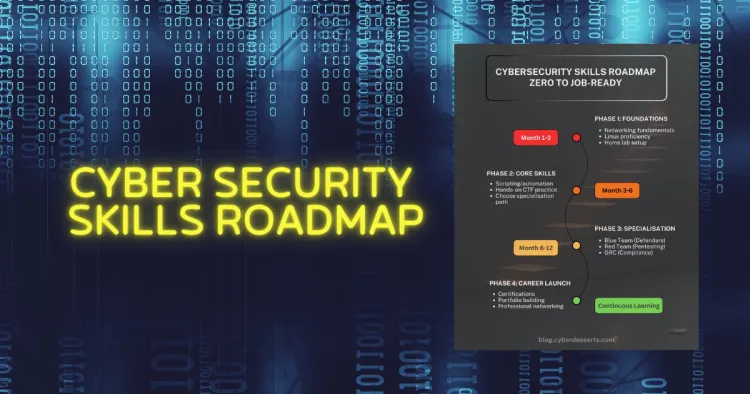
Start with the fundamentals. Learn networking (TCP/IP, DNS, HTTP), operating systems, and how attacks actually work. These matter more than any programming language. Our Cybersecurity Skills Roadmap maps the complete path from fundamentals to job-ready skills.
Pick up scripting as you go. Do not sit through a 40-hour Python course before touching security. Learn scripting in context. Automate something you are already doing manually. Write a script that solves a real problem.
Use AI as a force multiplier. When you hit a scripting challenge, use AI to draft the first version. Then study what it produced. This is the fastest way to learn coding concepts while building security skills simultaneously.
Choose your direction. If you want to be a penetration tester, invest more time in coding. If you want to work in GRC or security operations, invest more time in frameworks, threat analysis, and communication skills.
Frequently Asked Questions
Do you need coding for cybersecurity?
Not all cybersecurity roles require coding. Approximately 30-40% of cybersecurity jobs need little to no coding knowledge (CyberSeek). Roles in governance, risk management, compliance, security awareness, and SOC analysis can be performed without writing code. However, scripting knowledge in Python, Bash, or PowerShell gives you an advantage in almost every role.
Which cybersecurity roles require coding?
Penetration testers, security engineers, malware analysts, reverse engineers, and detection engineers typically need coding skills. These roles involve writing exploits, building security tools, analysing malicious code, or creating detection rules. Python, Bash, PowerShell, C, and Go are the most common languages used.
Which cybersecurity jobs don't require coding?
Security analysts, GRC professionals, security awareness trainers, security consultants, and incident response managers can work effectively without coding skills. These roles rely more on analytical thinking, communication, policy knowledge, and crisis management.
Can AI replace the need to learn coding for cybersecurity?
AI coding tools like GitHub Copilot and ChatGPT have significantly lowered the barrier to writing scripts and automation. However, you still need to understand what the code does, verify output, and troubleshoot errors. AI handles syntax but not the critical thinking that cybersecurity requires.
What programming language should I learn first for cybersecurity?
Python is the most recommended starting language for cybersecurity. It is widely used for automation, scripting, and security tools. Bash and PowerShell are also valuable for system administration and security operations. Your specialisation will determine which additional languages to learn.
Key Takeaways
- 30-40% of cybersecurity roles need little to no coding (CyberSeek)
- Scripting knowledge helps in every role, even when not required
- AI coding tools have lowered the barrier dramatically
- Understanding what code does matters more than writing it from scratch
- Your specialisation determines how much coding you need
Do not let coding anxiety stop you from entering cybersecurity. The field needs 4.8 million more professionals globally (ISC2, 2024). Many of those roles are waiting for people with analytical minds and problem-solving skills, not programming expertise.
Building your security career? Our Cybersecurity Skills Roadmap maps every step from foundations to your first role.
Cybersecurity hiring demand shows no sign of slowing. Subscribers get practical career guidance and skills content every week. No sales pitches, no fluff.
This article is part of our cybersecurity careers series. See the complete guide: Cybersecurity Skills Roadmap
Last updated: February 2026
References and Sources
- CyberSeek. Cybersecurity career pathway data. Approximately 30-40% of cybersecurity roles classified as requiring little to no coding knowledge.
- Bureau of Labor Statistics. (2024). Occupational Outlook Handbook: Information Security Analysts. Projected 33% growth from 2023 to 2033.
- ISC2. (2024). 2024 Cybersecurity Workforce Study. Global workforce gap of 4.8 million professionals, 19% increase from 2023.
- JetBrains. (2025). Developer Ecosystem Survey 2025. 85% of nearly 25,000 surveyed developers regularly use AI tools for coding.



Member discussion